


How to Choose a Padel Racket: The Complete UK Buying Guide
Choosing a padel racket can be confusing, particularly when every racket promises more power, control and performance. Our complete UK buying guide explains racket shape, balance, weight, materials and feel so you can find the right option for your level and playing style.
“Which padel racket should I buy?” is becoming one of the most common padel questions we get asked.
It is easy to see why. Start looking through different rackets and you are suddenly expected to understand round, teardrop and diamond shapes, low and high balance, soft and hard EVA, fibreglass, carbon fibre and a range of different weights.
That is before you even begin comparing brands, prices and playing levels.
The honest answer is that there is no single best padel racket for everybody. The best racket is the one that suits your current ability, feels comfortable in your hand and helps you play the type of padel you actually want to play.
A £200 attacking racket is not automatically better for you than a £70 control racket. In fact, buying a racket that is too powerful, too stiff or too difficult to handle can make the game harder rather than easier.
In this guide, we will explain the important differences without making things more complicated than they need to be.
Already ready to start looking? Browse our complete range of padel rackets from adidas, Bullpadel, Dunlop, HEAD, UWIN and Y1:
To view all of our padel rackets, click here
WHICH PADEL RACKET SHOULD YOU CHOOSE?
If you do not want to read the entire guide, here is the simple version:
• Complete beginners: Choose a round racket with a large sweet spot, low or medium balance and a soft, comfortable feel.
• Improving players: Look for a round or teardrop racket that offers a sensible mixture of control, comfort and usable power.
• All-round players: A teardrop-shaped racket with medium balance is usually a good place to start.
• Control-focused players: Look for a round shape, lower balance and a racket that feels easy to move.
• Attacking players: Consider a teardrop or diamond-shaped racket with more weight towards the head.
• Players who struggle with heavier rackets: Prioritise a lighter overall weight and low or medium balance.
These are useful starting points, not unbreakable rules. Two rackets can have the same shape and weight but feel completely different because of their balance, core, surface material and frame construction.
START WITH YOUR PLAYING LEVEL
The first question is not which brand you like or which professional player uses the racket.
It is: what level are you currently playing at?
CHOOSING A PADEL RACKET FOR A BEGINNER
When you are new to padel, control and forgiveness are far more useful than maximum power.
You will not hit every ball through the middle of the racket. Nobody does when they first start. A beginner-friendly racket normally gives you a larger sweet spot, a softer response and enough manoeuvrability to react quickly at the net.
Most beginners should look for:
• A round or forgiving teardrop shape
• A large sweet spot
• Low or medium balance
• A lightweight or medium-weight feel
• A soft or medium-soft core
• A comfortable fibreglass or forgiving composite surface
Do not worry about buying a racket you can “grow into” if it makes your first few months unnecessarily difficult. You will improve more quickly with a racket that helps you control the ball and build confidence.
Explore our beginner padel rackets:
https://one-sports-warehouse.com/collections/beginner-padel-rackets
You can also read our guide to the best beginner padel rackets:
https://one-sports-warehouse.com/blogs/news/best-beginner-padel-rackets
CHOOSING A PADEL RACKET FOR AN INTERMEDIATE PLAYER
Once you can rally consistently, use the walls and understand where you prefer to play, your choice of racket becomes more personal.
You might want more power on overhead shots. You might want better control when defending from the back of the court. You might simply want a racket that feels more stable when the pace of the game increases.
Intermediate players will often benefit from:
• A round or teardrop shape
• Low, medium or moderately high balance
• A medium-soft or medium core
• Fibreglass, carbon fibre or a hybrid surface
• More stability without making the racket difficult to move
This is also the point where it becomes worth thinking properly about your playing style rather than buying something labelled simply as an “intermediate racket”.
Browse our intermediate padel rackets:
https://one-sports-warehouse.com/collections/intermediate-padel-rackets
CHOOSING A PADEL RACKET FOR AN ADVANCED PLAYER
More experienced players usually have a clearer idea of the feel they want.
Some will choose a head-heavy diamond racket to generate more force through smashes and attacking volleys. Others will deliberately stay with a round, control-focused racket because they value placement, defence and quick handling.
Being an advanced player does not mean you have to use the hardest, heaviest or most expensive racket available. It simply means you are more likely to have the technique required to get the best from a demanding racket.
PADEL RACKET SHAPES EXPLAINED
Padel rackets are normally placed into three main shape categories:
• Round
• Teardrop
• Diamond
Shape influences where the sweet spot sits and how the racket generally feels, but it does not tell you everything. Balance, weight and construction still matter.
ROUND PADEL RACKETS
Round rackets usually have a larger, more central sweet spot and are commonly associated with control and manoeuvrability.
They are particularly useful for beginners because they are more forgiving when contact is slightly off-centre. They are also popular with experienced players who prefer precision, defence and quick reactions over outright power.
Round padel rackets are usually best for:
• Beginners
• Control-focused players
• Defensive players
• Players who value quick handling
• Anyone who wants a forgiving sweet spot
The downside is that some round rackets may not produce the same easy attacking power as a more head-heavy teardrop or diamond racket.
TEARDROP PADEL RACKETS
Teardrop rackets sit somewhere between round and diamond shapes.
They usually offer a good mixture of control and power, which makes them popular with improving and all-round players. The sweet spot tends to sit slightly higher than it does on a traditional round racket, but it is normally more forgiving than a full diamond shape.
Teardrop padel rackets are usually best for:
• Intermediate players
• All-round players
• Players who want control without sacrificing too much power
• Tennis players moving into padel
• Players who are still developing their preferred style
If you have played enough padel to move beyond a basic beginner racket but you are not looking for an extreme attacking setup, a teardrop racket is often a sensible place to start.
DIAMOND PADEL RACKETS
Diamond-shaped rackets normally place more of the hitting area and weight towards the top of the racket.
This can help experienced players generate more power through attacking shots, particularly smashes and aggressive volleys. The trade-off is that the sweet spot is often higher and less forgiving.
Diamond padel rackets are usually best for:
• Experienced players
• Aggressive attacking players
• Players who generate consistent contact
• Players looking for more weight behind overhead shots
A diamond shape should not normally be the automatic choice for a beginner. It may look like the most exciting option, but extra power is not much use if you cannot consistently control the ball.
WHAT DOES PADEL RACKET BALANCE MEAN?
Weight and balance are often treated as the same thing, but they are not.
Two rackets can weigh exactly the same amount and still feel completely different. One might carry more weight towards the handle, while the other places more weight in the head.
LOW-BALANCE PADEL RACKETS
A low-balance racket carries more of its weight towards the handle.
This normally makes the racket feel quicker and easier to move. It can be useful when reacting at the net, defending fast shots or making late adjustments.
Low balance is often a good option for beginners, control players and anyone who finds head-heavy rackets tiring.
MEDIUM-BALANCE PADEL RACKETS
A medium-balance racket spreads the weight more evenly between the handle and head.
This can provide a useful mixture of manoeuvrability, stability and power. Medium balance is commonly found in versatile teardrop rackets aimed at all-round players.
HIGH-BALANCE PADEL RACKETS
A high-balance racket carries more weight towards the top of the frame.
This extra weight can help experienced players put more force behind attacking shots. However, it can also make the racket feel slower and more tiring over a long match.
If you are choosing between two rackets with a similar overall weight, do not ignore balance. It may have a bigger effect on how the racket feels than a small difference on the scales.
SHOULD YOU CHOOSE A LIGHT OR HEAVY PADEL RACKET?
There is no perfect padel racket weight that suits everybody.
A lighter racket will generally feel easier to swing and quicker during fast exchanges. A heavier racket can feel more stable and may carry more weight through the ball, but only if you can move it comfortably and maintain good technique.
REASONS TO CHOOSE A LIGHTER PADEL RACKET
• It is generally easier to manoeuvre
• It can feel quicker during volleys
• It may be less tiring during longer matches
• It can help beginners prepare the racket earlier
• It may suit players who prefer fast reactions and control
REASONS TO CHOOSE A HEAVIER PADEL RACKET
• It can feel more stable against faster shots
• It may help experienced players generate heavier attacking shots
• It can feel more solid at contact
• It may suit physically stronger players with well-developed technique
Do not choose the heaviest racket you can physically swing. You need to be able to move it comfortably late in a match, not just during the first five minutes.
Remember that adding overgrips and frame protectors will also increase the finished weight and may slightly alter the balance.
FIBREGLASS VS CARBON FIBRE PADEL RACKETS
The surface material changes how a racket feels when it makes contact with the ball.
The two materials you will see most frequently are fibreglass and carbon fibre, although many rackets combine different materials across the frame and face.
FIBREGLASS PADEL RACKETS
Fibreglass normally provides a softer and more flexible feel.
This can make it easier to generate ball speed without swinging aggressively. It also tends to feel more comfortable and forgiving, which is why fibreglass is commonly used in beginner and recreational rackets.
Fibreglass may suit you if:
• You are new to padel
• You want a softer feel
• You value comfort and easy ball output
• You do not want to overspend on your first racket
CARBON FIBRE PADEL RACKETS
Carbon fibre is generally stiffer and more responsive than fibreglass.
This can give experienced players a more direct and precise response, particularly when they swing with enough speed to properly load the racket. Carbon is also widely used in higher-performance rackets.
Carbon fibre may suit you if:
• You play regularly
• You generate your own racket speed
• You prefer a firmer and more direct response
• You want additional stability during faster rallies
You may also see descriptions such as 3K, 6K, 12K or 18K carbon. These numbers refer to the construction of the carbon fibre, but a bigger number does not automatically mean the racket is better.
The overall racket design matters more than one specification. Shape, balance, core and frame construction all work together to create the final feel.
WHAT DOES THE CORE OF A PADEL RACKET DO?
Inside the racket is a foam or rubber core, most commonly described as EVA.
The hardness of the core influences comfort, ball response and how forgiving the racket feels.
SOFT EVA CORES
A softer core normally compresses more easily when the ball hits the racket.
This can provide a comfortable feel and help produce useful ball speed at slower swing speeds. It is often well suited to beginners, recreational players and anyone who prefers a less demanding racket.
MEDIUM EVA CORES
A medium core aims to balance comfort with a more direct response.
This is common in all-round rackets because it can suit a wide range of shots and playing styles.
HARD EVA CORES
A firmer core normally feels more direct and responsive when struck cleanly.
It can suit advanced players who generate plenty of racket speed, but it is usually less forgiving when contact is poor.
A hard racket is not automatically more powerful for everybody. If you cannot compress the core properly, it may actually feel harder to use.
DO YOU NEED POWER OR CONTROL?
Nearly every padel racket promises some combination of power and control.
The problem is that most players naturally choose power, even when control would do more to improve their game.
Padel is not simply about hitting the ball as hard as possible. Placement, patience, positioning and using the walls properly are often more valuable than raw racket speed.
CHOOSE A CONTROL-FOCUSED RACKET IF:
• You are still learning consistent contact
• You prefer placement and accuracy
• You spend plenty of time defending
• You want a larger and more forgiving sweet spot
• You value quick handling at the net
CHOOSE A POWER-FOCUSED RACKET IF:
• You already strike the ball consistently
• You play an aggressive attacking game
• You regularly use smashes and attacking volleys
• You are comfortable with a smaller or higher sweet spot
• You have the technique to control a more demanding racket
Many players will be best served by something in the middle. An all-round racket gives you enough help in attack without making defence unnecessarily difficult.
WHICH PADEL RACKET IS BEST FOR YOUR PLAYING STYLE?
DEFENSIVE AND CONTROL PLAYERS
Look for a round racket with a large sweet spot and low or medium balance. A softer or medium core can also help with comfort and controlled ball placement.
ALL-ROUND PLAYERS
A teardrop racket with medium balance is often a strong option. It should give you enough manoeuvrability for defence while still providing support when you move forward to attack.
AGGRESSIVE ATTACKING PLAYERS
Experienced attackers may prefer a teardrop or diamond racket with medium-high or high balance. A firmer surface and core can provide a more direct response, but the racket will normally demand cleaner contact.
FAST NET PLAYERS
If your game relies on quick reactions and rapid volleys, do not overlook manoeuvrability. A lighter or lower-balanced racket may be more useful than extra static weight.
HOW MUCH SHOULD YOU SPEND ON A PADEL RACKET?
You do not need to spend hundreds of pounds to get a good padel racket.
As a rough guide:
• Under £60: Entry-level rackets for new, junior or occasional players.
• £60 to £100: A strong area for beginners and improving recreational players.
• £100 to £160: More performance-focused options for regular and intermediate players.
• Over £160: Premium rackets using advanced materials and constructions, generally aimed at committed or experienced players.
Prices can move as models change and older colourways go into sale, so do not judge a racket only by its recommended retail price.
The best-value racket is the one that suits your level and gets used regularly. An expensive professional racket sitting in a cupboard is not a bargain.
WHICH PADEL RACKET BRAND SHOULD YOU CHOOSE?
There are plenty of strong padel brands, but the logo should not be the first thing you choose.
Start with the type of racket you need, then compare suitable options across different brands.
ADIDAS PADEL RACKETS
adidas padel rackets include options for newer players alongside higher-performance control and attacking models.
https://one-sports-warehouse.com/collections/adidas-padel
BULLPADEL PADEL RACKETS
Bullpadel padel rackets cover a broad selection of playing levels and include control, all-round and power-focused designs.
https://one-sports-warehouse.com/collections/bullpadel-padel
DUNLOP PADEL RACKETS
Dunlop padel rackets include accessible options for beginners and improving players.
https://one-sports-warehouse.com/collections/dunlop-padel-rackets
HEAD PADEL RACKETS
HEAD padel rackets offer a wide choice of shapes, weights and performance levels.
https://one-sports-warehouse.com/collections/head-padel-rackets
UWIN PADEL RACKETS
UWIN padel rackets provide beginner-friendly and good-value options, including junior rackets.
https://one-sports-warehouse.com/collections/uwin-padel-rackets
Y1 PADEL RACKETS
Y1 padel rackets include control, all-round and performance-focused designs for different levels of player.
https://one-sports-warehouse.com/collections/y1-padel-rackets
Do not be afraid to compare brands. A player who loves an adidas racket may not enjoy every adidas model, just as somebody who normally plays with Bullpadel may find a particular Y1 or HEAD racket better suited to their game.
DO PADEL RACKETS HAVE DIFFERENT GRIP SIZES?
Unlike tennis rackets, padel rackets are not normally sold in a large range of grip sizes.
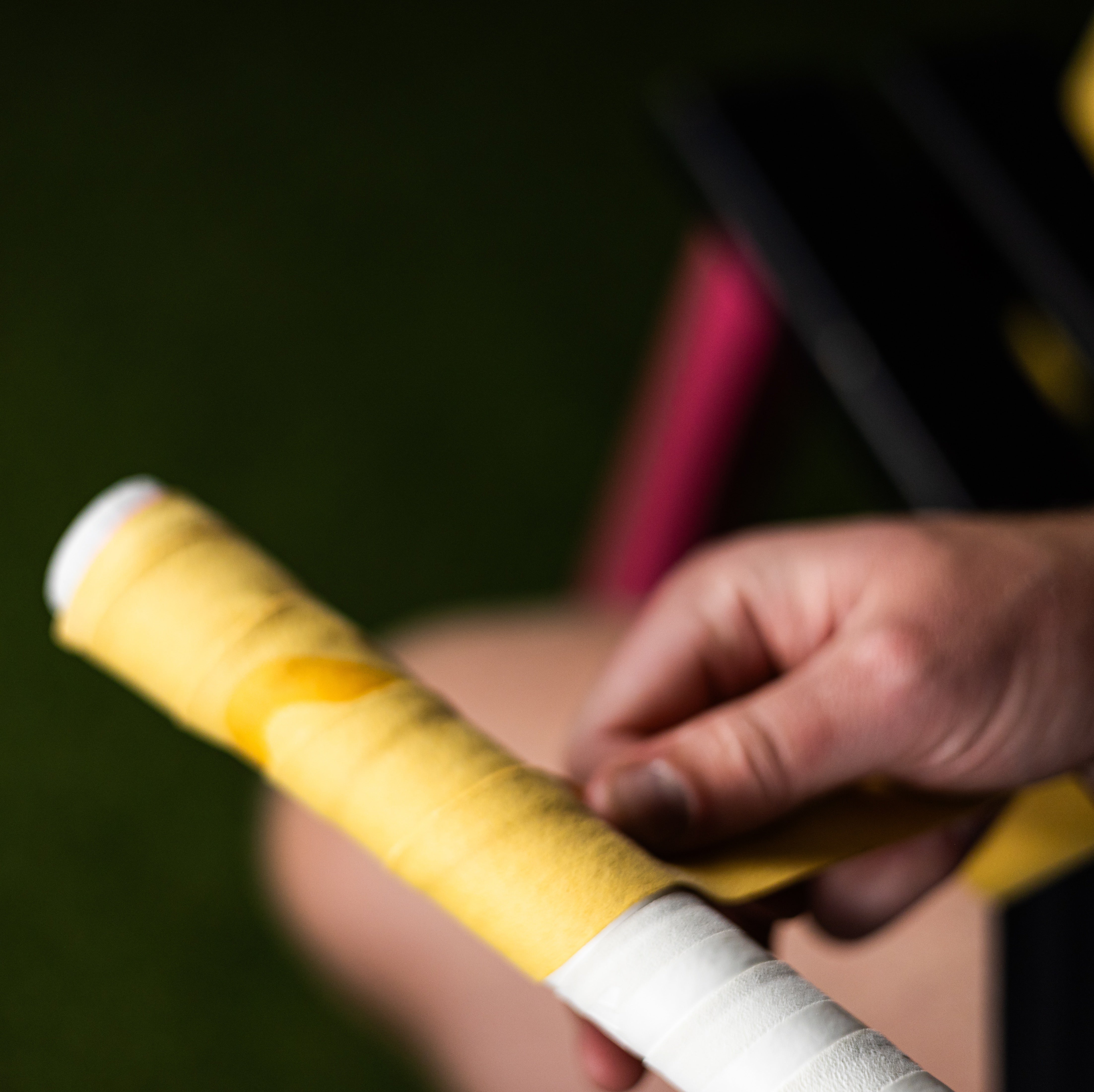
Players usually adjust the handle by adding one or more overgrips. This can improve comfort, absorb moisture and make the grip feel more secure.
However, adding too many overgrips can make the handle feel bulky and reduce your ability to relax the hand. It will also add a small amount of weight towards the handle.
Browse our range of padel grips and overgrips if your current handle feels too thin, slippery or worn:
https://one-sports-warehouse.com/collections/padel-grips
COMMON MISTAKES WHEN BUYING A PADEL RACKET
BUYING THE RACKET USED BY A PROFESSIONAL
Professional players have exceptional timing, strength and technique. Their racket may be designed around requirements that bear little resemblance to yours.
CHOOSING MAXIMUM POWER AS A BEGINNER
Power sounds attractive, but control and forgiveness will normally help a new player improve more quickly.
IGNORING BALANCE
A racket can look lightweight on paper and still feel heavy if most of the weight sits near the top of the frame.
ASSUMING CARBON IS ALWAYS BETTER
Carbon fibre is not automatically the right material for every player. A softer fibreglass racket may feel more comfortable and produce better results for a beginner.
BUYING ENTIRELY ON APPEARANCE
We all want a racket that looks good. Just make sure the shape, weight and feel are right before allowing the colourway to make the final decision.
BUYING A RACKET THAT IS TOO ADVANCED
A demanding racket will not force you to become a better player. More often, it will make poor contact feel worse and reduce your confidence.
OUR SIMPLE PADEL RACKET CHECKLIST
Before buying, ask yourself the following questions:
• What is my genuine current playing level?
• Do I want control, power or a mixture of both?
• Do I prefer a round, teardrop or diamond shape?
• Does the balance suit my strength and swing?
• Can I move the racket quickly and comfortably?
• Do I prefer a soft or firm feel?
• Am I paying for features I will actually use?
If you cannot answer all of these yet, do not panic. Start with playing level, shape and balance. Those three choices will narrow the options considerably.
PADEL RACKET FAQS
WHAT IS THE BEST PADEL RACKET SHAPE FOR BEGINNERS?
A round shape is normally the safest choice for a beginner. It generally provides a larger sweet spot, good control and a forgiving feel when contact is not perfect.
IS A ROUND OR TEARDROP PADEL RACKET BETTER?
Round rackets are normally better for control and forgiveness. Teardrop rackets offer a more even mixture of control and power.
The right choice depends on your experience and preferred style.
ARE DIAMOND PADEL RACKETS ONLY FOR ADVANCED PLAYERS?
They are not exclusively for advanced players, but they are generally more demanding.
Their higher sweet spot and head-heavy feel tend to suit experienced attacking players.
IS A CARBON PADEL RACKET BETTER THAN FIBREGLASS?
Not necessarily.
Carbon fibre normally provides a firmer and more responsive feel, while fibreglass is generally softer and more forgiving.
The better option is the one that suits your ability and preferred feel.
SHOULD A PADEL RACKET BE LIGHT OR HEAVY?
A lighter racket is generally easier to manoeuvre, while a heavier racket can offer more stability.
Balance is just as important as total weight, so compare how rackets feel rather than looking at weight alone.
HOW MUCH SHOULD A BEGINNER SPEND ON A PADEL RACKET?
Many beginners can find a suitable first racket between approximately £50 and £100.
There is no need to buy a professional-level racket when control, comfort and forgiveness are your main priorities.
WHEN SHOULD I UPGRADE MY PADEL RACKET?
Consider upgrading when your current racket is damaged, no longer feels comfortable or starts limiting a part of your game.
You may also be ready to upgrade once you understand whether you prefer control, power or all-round performance.
CAN TENNIS PLAYERS USE AN ADVANCED PADEL RACKET IMMEDIATELY?
Good racket skills may help, but padel technique is different from tennis.
Many tennis players are better starting with a forgiving round or teardrop racket while they learn the walls, shorter swings and court positioning.
FINAL THOUGHTS
The best padel racket is not automatically the most powerful, expensive or technically advanced model.
It is the racket that feels comfortable, suits your current ability and helps you play with confidence.
For beginners, that will normally mean a forgiving round racket with a large sweet spot and low or medium balance.
Improving players may prefer the versatility of a teardrop shape, while experienced attacking players might benefit from a more powerful diamond design.
Start by being honest about your level. Decide whether you need control, power or a mixture of both. Then consider shape, balance, weight and materials.
Once you understand those basics, choosing a padel racket becomes much easier.
Explore our complete range of padel rackets at ONE Sports Warehouse:
https://one-sports-warehouse.com/collections/padel-rackets
Browse our full range of padel equipment:
https://one-sports-warehouse.com/collections/all-padel
Shop padel balls:
https://one-sports-warehouse.com/collections/padel-balls
Shop padel grips: